
About Koidra
AI in the physical world
The AI wave that rewrote the digital economy has barely touched the factories, plants and greenhouses that consume most of its energy. We build for that half.
The problem
The data these systems run on is in no text corpus
An operator running a dryer, a chiller plant or a glasshouse is not working with documents. They make a control decision, watch how the physical system responds, and adjust the next one. That loop produces the only data describing how their particular plant behaves, and it exists nowhere else. It cannot be absorbed by reading manuals or papers.
This is why a language model, however capable, is not a controller for a live process. It reasons over text rather than over state estimated from sensor streams, it does not model thermodynamics or machinery, and it carries none of the guarantees that writing a setpoint back to a plant requires.
Most of what gets called physical AI is about robots: machines that move through the world with cameras and motors. That is a real problem and it is a different one.
The physical world that consumes the most energy is the one already standing still:
- heating and cooling systems;
- drying and pasteurization lines;
- greenhouse climate;
- chiller plants and thermal processing.
They run every hour of every day, they account for a large share of the energy the world uses, and almost all of them are still driven by a person or by rules configured decades ago.
Founder
Kenneth Tran
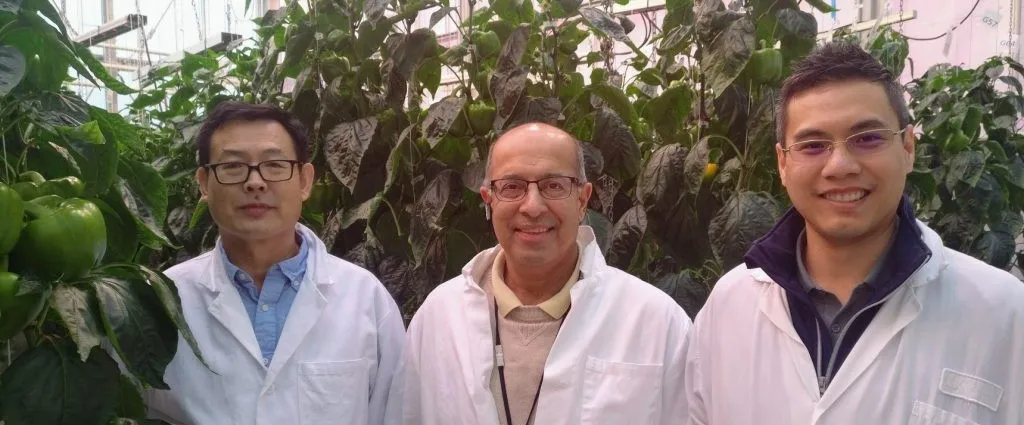
Dr Kenneth Tran spent his research career at Microsoft Research on reinforcement learning for the physical world: AI that learns from interaction with complex physical environments and can be trusted to act on them. He led the work on model-based reinforcement learning for operational optimal control, a class of algorithms that are sample efficient, off policy and transferable. That matters because a plant will not give you a million episodes to learn from, and a wrong action costs hardware or a crop. The project named two target applications in 2017: indoor farm control, and data center energy consumption. Both are Koidra industries today, and the project page is still public.
Under his leadership the Microsoft team won the first international Autonomous Greenhouse Challenge in 2018: the first time a crop was grown remotely on AI, and the only AI entry to finish ahead of the expert growers. A Koidra team won it again in 2022. The method behind both, physics-informed deep learning for simulating and controlling physical systems, is now covered by a US patent, cited below.
Koidra is that research carried into live plants. The same kind of agent that held a competition greenhouse now runs setpoints in commercial greenhouses and in industrial dryers and boilers.
The approach
Three parts, and none of them is a chatbot
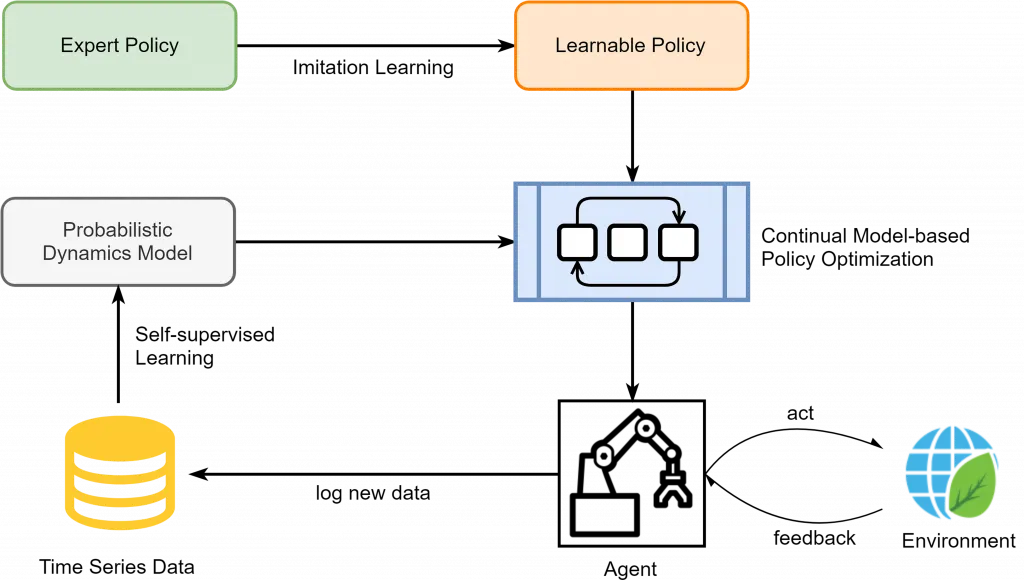
Koidra builds control agents for physical systems. They automate the decisions that regulate temperature, humidity, pressure, flow and energy use, minute by minute. The goal is not to replace the equipment already in a facility. It is to give that equipment a better brain.
- A world model of your facility
- A digital twin built from sensor streams, control logs and domain knowledge, describing how this site behaves rather than how a site of this type behaves.
- Model-based reinforcement learning
- Control strategies are evaluated over time rather than optimized one step ahead, so a move that looks good this minute is rejected when it costs more over the next four hours.
- First-principles physics
- Energy balance, mass balance, heat transfer, fluid dynamics and equipment limits are built in, so the agent cannot propose something the plant cannot do.
The method is covered by US patent 12,197,176, granted in January 2025, for simulation and automated control of physical systems using physics-informed deep learning.
See Koidra on your own plant data
Bring a week of readings from one line. We will show you what the platform sees, what it would have flagged, and what it would have scheduled.
Book a demo