
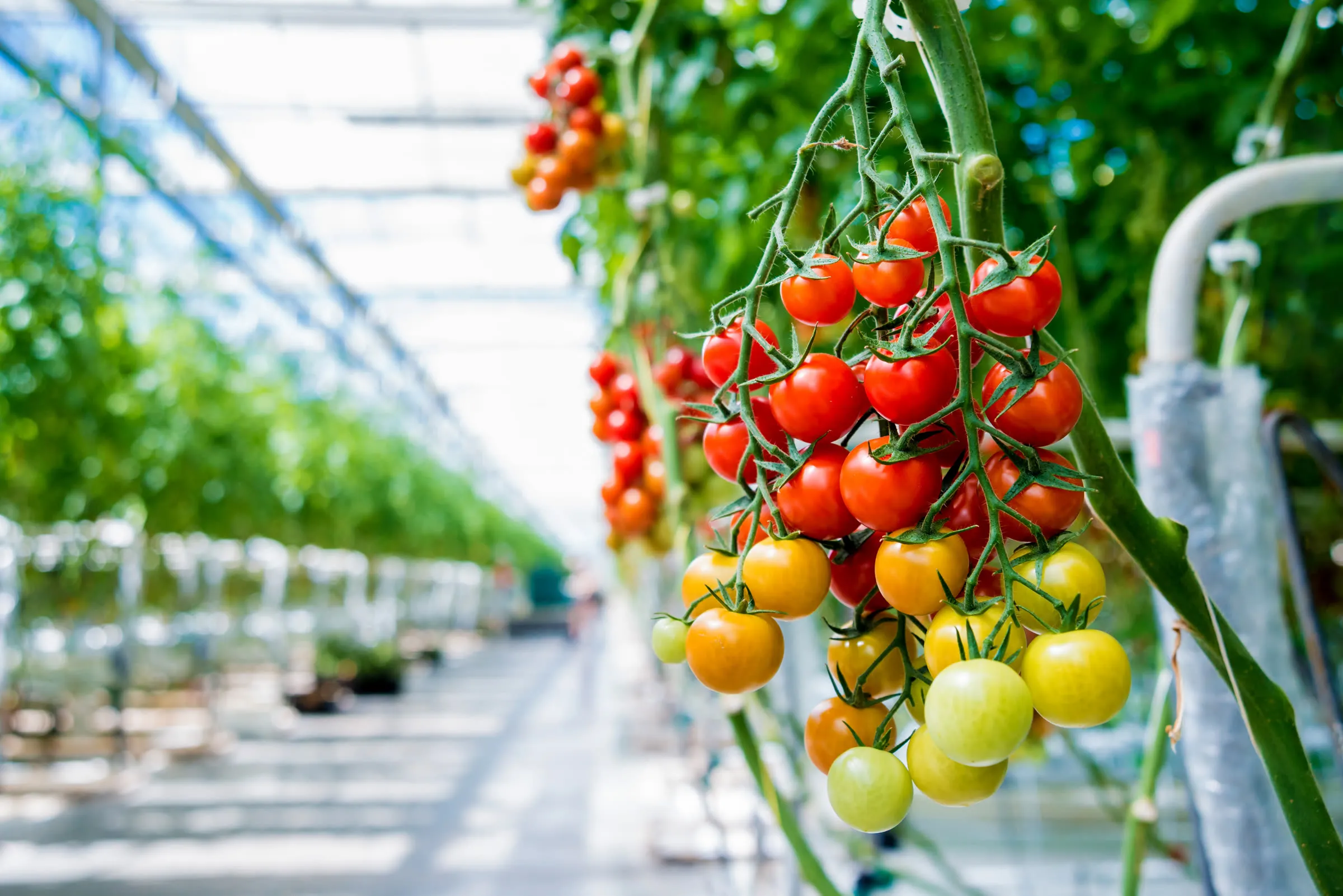
Climate, irrigation and yield
Greenhouse Farming
Greenhouse performance depends on thousands of climate and irrigation decisions made throughout the crop cycle. Many of those decisions still depend heavily on grower experience and manual adjustment. When that knowledge is not captured systematically, it becomes difficult to understand why one crop performed better than another, reproduce a successful strategy at another site, or maintain the same level of control when an experienced grower is unavailable.
What goes wrong, and what it costs
- Yield inconsistency
- Each greenhouse site experiences varying degrees of yield inconsistency due to fluctuating environmental conditions, affecting the quality and quantity of produce.
- Resource management
- The grower constantly juggles water, nutrients and energy to hit quality targets and reduce waste, but lacks precise control over these resources.
- Qualified expertise and retention
- Finding skilled expertise that can follow strict growing protocols is a challenge, resulting in a knowledge gap and operational inefficiencies.
- Technology optimization
- The grower's hands-on approach leaves them stretched thin, with less time to focus on strategic planning and research for yield improvement.
- Operational visibility
- With a manual, piecemeal approach to data collection and analysis, the grower has limited visibility into the real-time performance of the growing operations.
What that gives a grower
- Control that considers both climate and crop
- KoPilot combines greenhouse climate models with crop information and grower-entered crop registration, so control decisions can reflect both environmental conditions and crop development.
- Crop registration where the measurements are taken
- Growers can record crop measurements and observations from a phone or tablet in the greenhouse, reducing the delay between observing the crop and making that information available for analysis and control.
- Operational context in one place
- Climate data, crop measurements, photographs, alarms and maintenance history can be connected by compartment and time, making it easier to understand what happened and why.
- Alerts that reach the right person
- When a climate or equipment condition needs attention, notifications can be delivered directly to the people responsible rather than remaining on a control-room screen.
Already evaluating another system? See how Koidra compares with Blue Radix and with Hoogendoorn’s Intelligent Algorithms.
For a hi-tech greenhouse with a climate computer
A hi-tech greenhouse starts with DataPilot, because the climate computer is there to connect and the growers’ crop registration comes with it, or with Maintenance Management, which needs nothing connected. AI Advisory needs both and comes with both, and KoPilot runs the climate on top of that record.
For a mid- or low-tech greenhouse
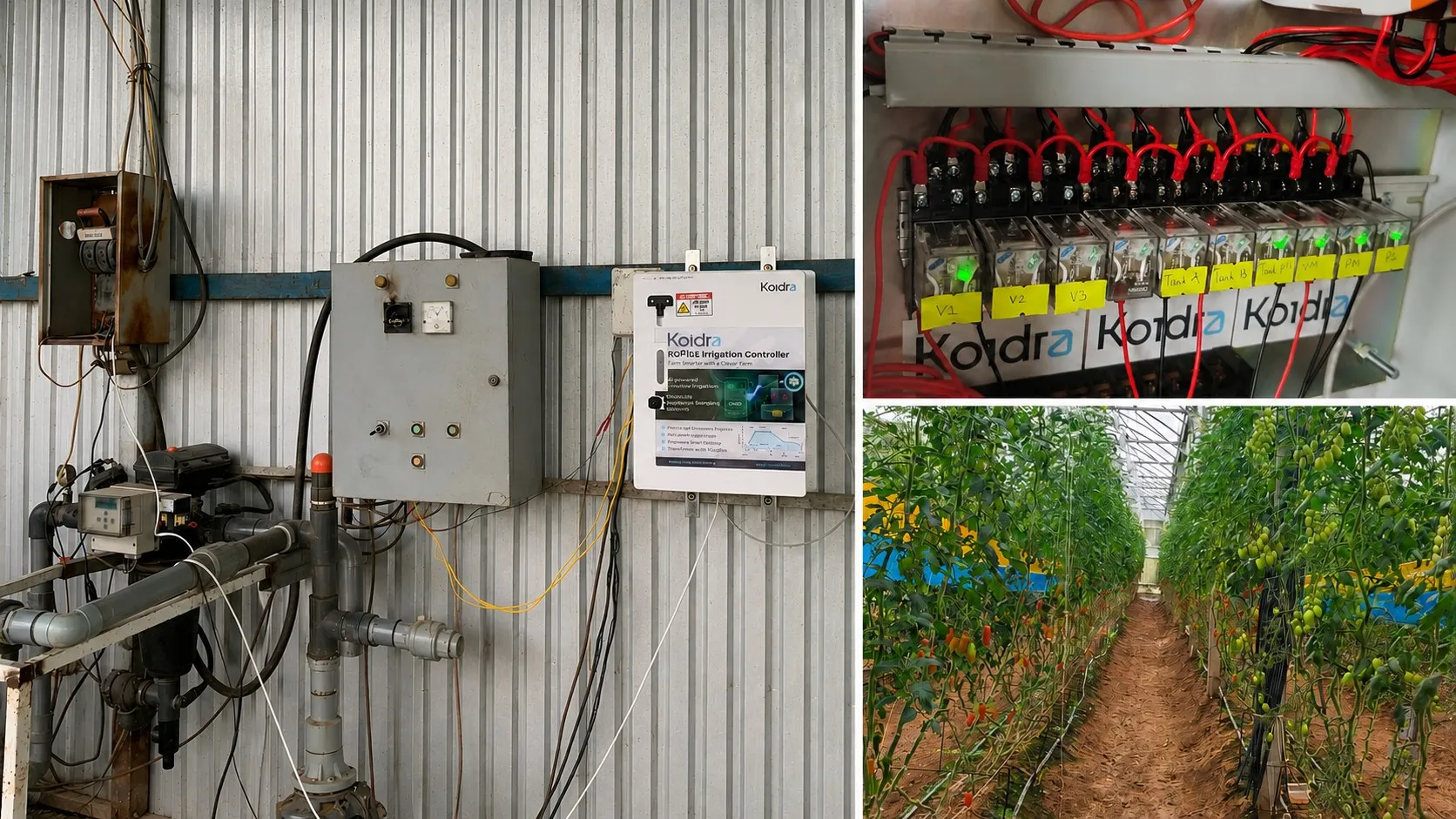
A greenhouse without an advanced climate computer takes a different path. DripPilot is a separate product: autonomous irrigation on its own controller, for the houses where water is the biggest lever and there is no climate computer to build on. It reads irrigation, climate and root-zone sensors and decides when to irrigate, how much, and what drain percentage and EC to hold. It is not a step on the path above, and not an add-on to KoPilot.
What each product gives a greenhouse like yours
Two ways in, a layer that needs both, and control on top. Each is a complete product with its own payback. Here is what they do here rather than in general.
-
Start here
DataPilot
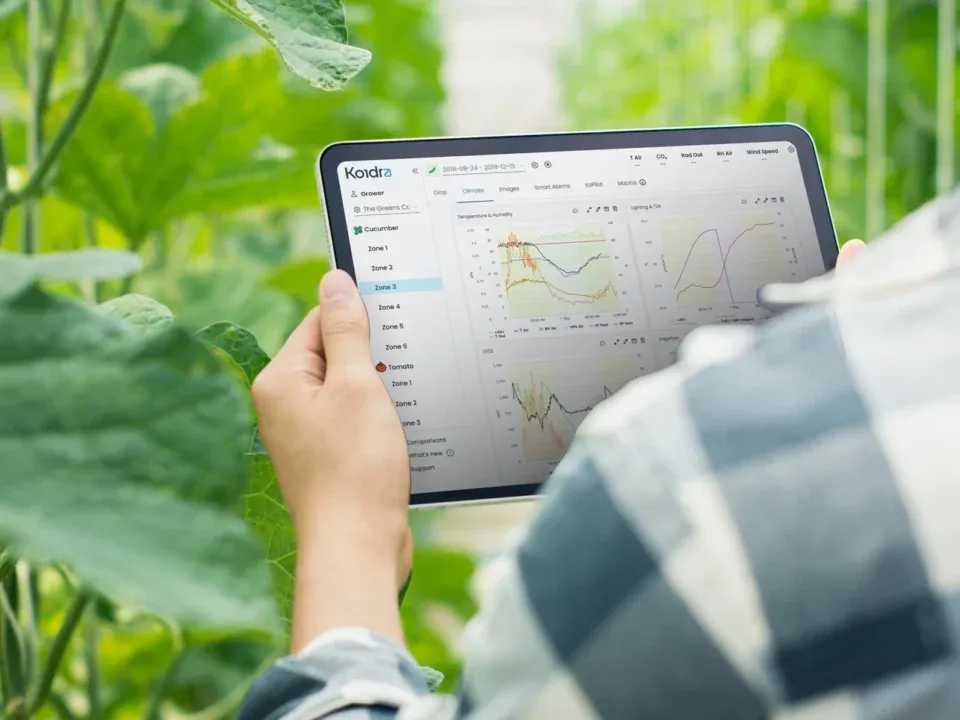
Climate computer data, irrigation activity, drain percentage and the crop measurements your growers enter sit together by compartment and time. A change in the crop can be traced to what the climate did, and an alarm reaches the person who has to respond rather than a control-room screen.
-
Start here
Maintenance Management
Screens, vents, pumps, boilers and drip lines each keep their own service history and check dates, so a problem is dealt with before it reaches the crop. There is no maintenance department to run: a job goes to the grower who handles it, or to the service company you call, and closes with a photo.
-
Comes with both
AI Advisory
A regular summary of what the crop experienced, daily light integral, 24-hour average temperature and vapor pressure deficit, against the strategy you intended, with a recommendation on what to adjust. The target you name, as a number or in words, is what the recommendation aims at.
-
Autonomous control
KoPilot
Screen, vent, heating and other climate setpoints adjusted continuously from current conditions, crop objectives and the weather forecast, inside limits you set for the greenhouse. The strategy runs the same on every shift, whoever is on.
Proof
- 2×
- Winner, Autonomous Greenhouse Challenge 2018 and 2022, a live crop each time
- 17%
- Higher net profit than the expert growers 2018 competition, with 6% higher yield
- 19.5%
- Yield increase on cucumber against a control zone grown manually alongside it
- 17%
- Energy savings in the same commercial trial
Tested in international competition and in commercial production, and the 2018 competition run was the only AI entry to finish ahead of the expert growers on both yield and net profit. That is the difference between software that recommends a climate strategy and a system that calculates and applies control decisions, continuously.
What we measure here
- compartment
- screen position
- vapor pressure deficit
- daily light integral
- irrigation shot
- drain percentage
- electrical conductivity
- 24-hour average temperature
What our customers say
We wanted a ‘digital assistant grower’ — someone who never sleeps, reacts instantly to live data, and follows our instructions without bias. Our priority was speed and accuracy, especially for light and CO₂ strategies, because they drive a large part of the budget. KoPilot promised quicker decisions and tighter control in those areas. Dynamic lighting that factors in real-time electricity prices and radiation is a game-changer — saving energy without sacrificing crop performance.
I have seen firsthand the impact of Koidra’s DataPilot on controlled environment agriculture. The ‘actionable insights’ feature has been pivotal in translating real-time data into strategic actions, significantly supporting us to optimize growing conditions. What I like the most is that DataPilot allows me to easily show sensor readings from the climate controller and separately installed sensors in the same dashboard. Another feature I like is that creating new insights using raw data and advanced calculations is relatively simple.
See Koidra on your greenhouse data
Bring a week of readings from one compartment. We will show you what the platform sees, what it would have flagged, and what it would have scheduled.
Book a demo