
A Cracked Dryer Fan, and the Four Months of Data That Saw It Coming
Customer story Maintenance DataPilot Biomass energy
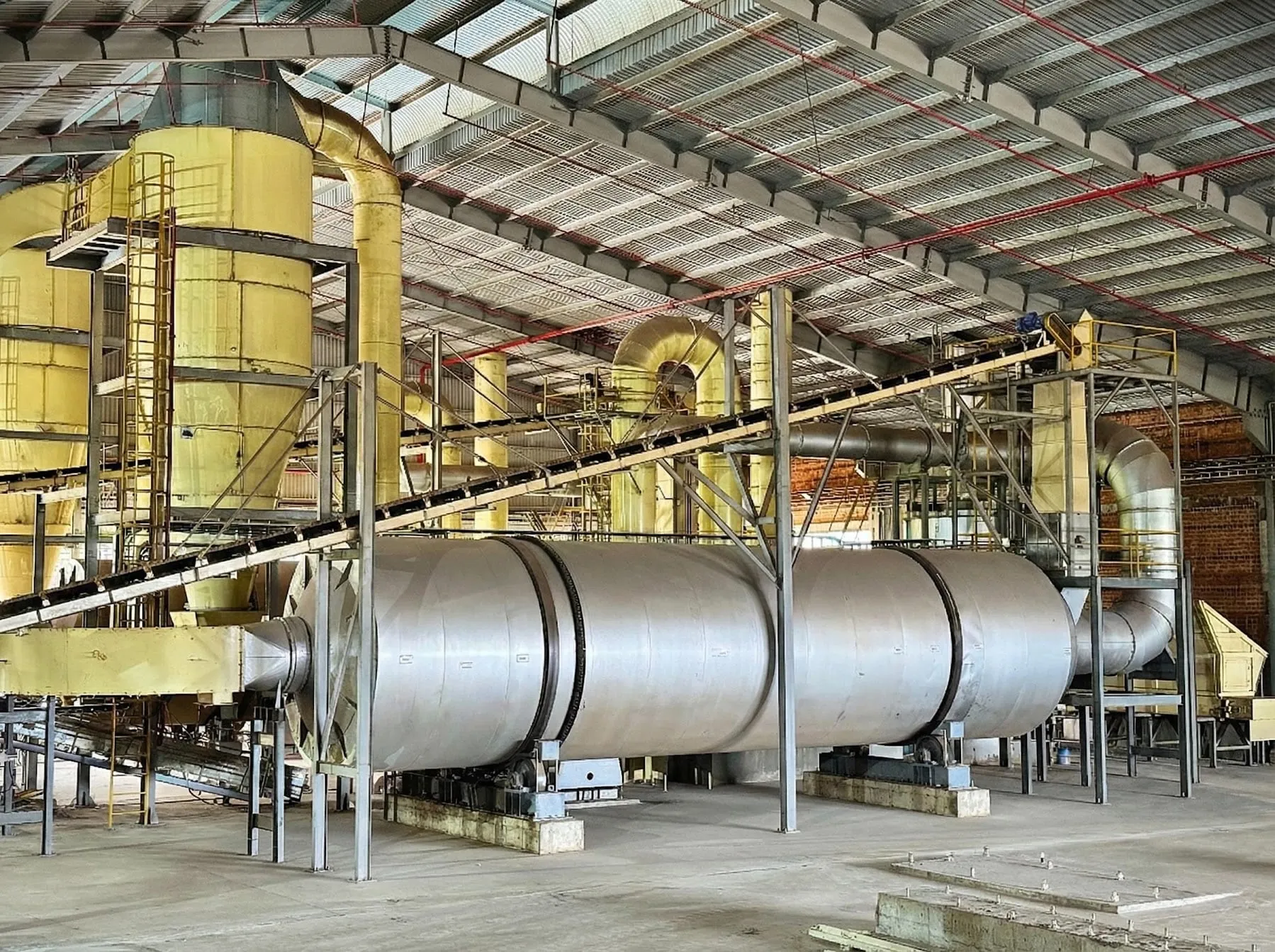
At seven in the evening on 20 June 2026, the drying line at Ayo Biomass’s M’Drak plant was started back up after a day down for a chain repair. The SCADA screen showed the induced-draught fan, DFA-022, vibrating at about 10 mm/s. A maintenance technician put a handheld meter on the same bearing and read 18.8 mm/s.
They opened the casing. The impeller carried a dust cake 20 mm thick, and it was not the same all the way round: the top of the blade was dry and flaking off, the bottom was still damp and packed on. Under the cake, three cracks ran along the centre rib.
Six days of lost production, an estimated 300 million VND a day, twenty-six people working through it. The lost production alone came to about 1.9 billion VND. With the repair and the people, the failure cost close to $100,000.
This is what the investigation found, and why the answer was not the one everybody started with.
The obvious answer was the wrong one
An unbalanced rotor is what a 20 mm cake of dust produces, and unbalance is what the numbers said. The plant had been there before: the supplier had been called out to rebalance the fan, and the problem came back.
That is the tell. Unbalance is a symptom. Stopping there means the corrective action is “rebalance it”, and the next failure is already scheduled. The question that matters is why there was a cake at all.
Dry dust does not stick
Wood dust that is dry falls off a spinning impeller. It only builds into a cake if it is wet, and it is only wet if water is condensing on the blade. Condensation on the blade means the gas reaching the fan is below its dew point.
So the investigation went to the temperature record. The plant’s own SOP puts the dryer exhaust at 97°C. The drum had been running at 81 to 84°C, and drifting down toward 77°C across three months. Nobody had compared the two numbers, because the exhaust temperature was not a controlled parameter: the dryer was run on outlet moisture, and the gas temperature was a reading with no specification, no alarm and no owner.
The margin matters more than the number. Exhaust dew point at this plant sits somewhere around 55 to 70°C. At 81°C the margin is 10 to 30°C at the drum outlet, and the gas keeps cooling all the way down the duct to the fan.
The comparison that settles it is Ayo’s own second plant. Quy Nhon runs the same equipment on the same bark fuel and has gone years without this failure. Its dryer outlet sits at 98 to 124°C, which is 30 to 60°C above the dew point, and its dust stays dry.
One caveat belongs here, because the investigation added it to its own findings on 29 July. There is no gas temperature sensor at the fan. The two channels named TT01 and TT02 measure bearing temperature, not gas. The claim that the gas was below its dew point at the fan rests on the wet dust that people saw when they opened the casing, not on a measurement. Closing that gap, by measuring gas temperature at the fan inlet, is one of the corrective actions.
The crack was months old
A single bad start does not crack a steel rib. Pulling the vibration trend back to the start of May showed a sawtooth: vibration climbing from 2 or 3 mm/s up to somewhere between 7 and 17 over five to ten running days, dropping back after a cleaning, then climbing again. At least five cycles, on both fans on both lines.
Each cycle is millions of revolutions under load the blade was not designed to carry. The crack is accumulated fatigue over months. The twentieth of June was where it finished, not where it started.
The restart itself is visible in the five-minute data, and it is quick. The fan ran smoothly from 17 to 19 June at 1.7 to 2.7 mm/s. Then the line stopped for the chain repair. At 19:00 on 20 June it started again, and over the next twenty minutes vibration went from 7.5 to 9.9 mm/s. One stop and restart turned a quiet fan into a badly unbalanced one, because the cake dried on the top of the blade and stayed wet on the bottom while the machine sat still.
Four alerts, each closed on its own
In the five weeks before the crack there were four vibration alerts: 18 May, 19 May, 1 June and 11 June. Every one of them was handled as an incident and the line ran on.
Meanwhile the fan on the other line, DFA-012, spent roughly 118 hours running above 11 mm/s, across two spells: 12.0 climbing to 14.0 mm/s between 11 and 13 May, and 12.9 climbing to 17.1 between 27 May and 1 June. It sat continuously above 7.1 mm/s from 24 May to 1 June. Vibration was displayed on a screen. It was not wired to an alarm, a trip or a start interlock, so none of those hours stopped anything.
The preventive maintenance routine for these fans was created on 18 May, which is after the first alert. Quy Nhon has had a daily checklist on its dryer fan since February, with 240 work orders completed against it. Some of the M’Drak work orders were skipped on exactly the days the trend was worst.
The instrument that reported safety
The strongest finding came out of a different investigation, and it is the reason this one was re-checked in August.
A furnace RCA found that a temperature channel was frozen: reporting the same value for hours at a stretch. The channel was DDD_011_TT02, which is the single most load-bearing channel in the fan investigation. It was frozen 25.5% of the time. Its counterpart on line 2 was frozen 12.3% of the time.
The first question was whether the fan RCA still held. Recomputing the exhaust temperature using only the hours the dryer was actually running, and discarding every frozen stretch, gives a median of 81.1°C on line 1 and 81.8°C on line 2. The original 81 to 84°C survived intact, and so did the gap to Quy Nhon, at 98.2°C and 117.9°C on its two dryers.
But the re-check turned up something the original investigation had missed, and it is worse than what it was checking.
When the dryer is stopped, the real gas temperature in the duct falls to a median of 29.7°C. That is 25 to 40°C below the dew point band. Every stop is a condensation event. Not only the 24-hour chain repair: every stop.
Nobody had seen this, because during 384 hours of stopped time the frozen channel was reporting above 60°C. It was stuck at 90, at 85, at 77.4, at 65. It read above 80°C for 190 of those hours.
An instrument that fails to zero gets noticed within a shift. An instrument that freezes at a plausible value reports safety, and it reported safety during precisely the hours that were doing the damage.
The fix generalises past this one channel. A frozen channel has a signature that no real process has: its standard deviation over a window is zero while the equipment is running. That is now an alarm across every temperature channel at the plant, not just the one that was caught.
What the investigation changed
The corrective actions divide cleanly, and the division is the point.
Physical: replace the impeller, non-destructive testing on the sister fan DFA-012, repair the vibration channel VS01 on both fans and check the 4 to 20 mA scaling, because SCADA was reading about half what the handheld meter read at the same point.
Control: bring the dryer exhaust back to the SOP band of 95 to 100°C. Alarm vibration at 7.1 mm/s and trip at 11, with an interlock that refuses a start while vibration is high. Alarm any temperature channel whose standard deviation goes to zero while its equipment runs.
Practice: clean the impeller after every stop rather than on a weekly calendar, because the data now says every stop puts the duct below the dew point, and a fixed weekly schedule was always out of phase with a cake that builds at half a millimetre to a millimetre a day. Track a new number: hours spent below the dew point after each stop.
Fixing only the first group changes the date of the next failure and nothing else.
What generalises
Three things carry past this fan.
A symptom that recurs after a correct repair is telling you the cause is upstream of the repair. The rebalance was competent work. It came back because it was answering the wrong question.
A reading with no specification is not a measurement, it is decoration. The exhaust temperature was on a screen for three months at 15°C under its own SOP value, and no rule anywhere in the plant was violated by that, so nothing happened. A number nobody can be wrong against does not constrain anything.
Sensor health is a first-class signal. Four channels in this story were lying: one vibration channel stuck near 20 mm/s for three months and reported in May but never fixed, one zeroed by applying an offset instead of a calibration, one reading half the true value, and one temperature channel frozen at a comfortable number for 384 hours. Every decision made from those screens was made in good faith. The instrument that is quietly wrong is more dangerous than the instrument that is obviously broken, and no maintenance system will tell you which one you have unless you ask it to.
None of this needed a new sensor. The vibration trend, the exhaust temperatures, the work order history and the shift reports were all being recorded the whole time. What was missing was one place where they sat on the same clock, and a rule that could be violated.