
Climate, irrigation and yield
Greenhouse Farming
Intelligent Greenhouse Automation
Boost greenhouse production with AI
What changes in your greenhouse
- 40%
- of a Dutch vegetable grower's costs went to energy in 2022 Wageningen Economic Research, 2023
- 42%
- of US greenhouse and nursery production costs go to wages and contract labor USDA Economic Research Service, from the 2022 Census of Agriculture
- 17%
- less nutrient solution when sensors decide irrigation instead of a timer, at the same crop weight Montesano et al., Horticultural Science, 2016. Soilless lettuce.
- Less gas and power in every kilo
- Heating, lighting and screens decide most of the energy bill. Setting them hour by hour against the weather forecast and the power price lowers what each kilo costs to grow.
- More kilos from the same glass
- The crop responds to light, temperature and CO₂ together. Control that follows the crop, not a fixed recipe, turns more of each day into growth.
- Water and fertilizer by what the crop needs
- Irrigating on what the root zone measures, not on a timer, gives the crop what it uses and sends less to the drain.
- Your best grower's strategy in every compartment
- Good growers are scarce and hard to keep. Their strategy runs the same way day and night, in every compartment, whoever is on shift.
For a hi-tech greenhouse with a climate computer
Process Optimization connects to the climate computer and puts your growers’ crop registration beside its data. Its Essential plan brings the data and your crew’s work orders, Pro adds AI advice, and KoPilot runs the climate.
Process Optimization · Essential
-
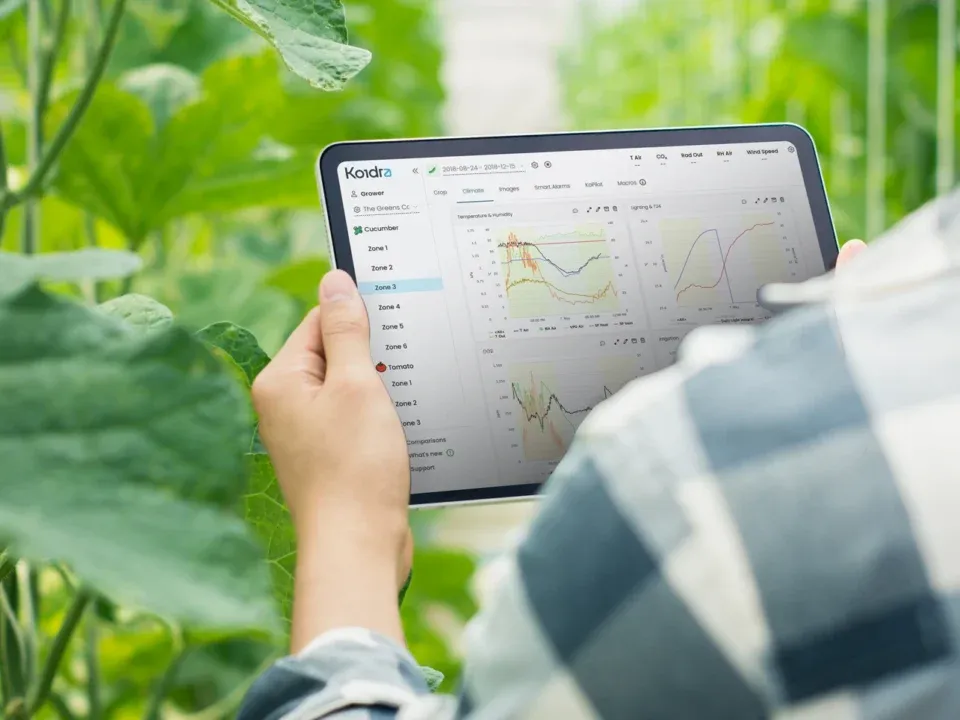
Climate computer data, irrigation, drain percentage and your growers' crop measurements in one place, compartment by compartment, over time. When the crop changes, you can see what the climate did before it. An alarm goes to the person who has to act, not only to a control-room screen.
-
Work-order management
Three kinds of greenhouse work run on your growers' phones. Crop registration is entered in the aisle, plant by plant and even without a signal, with the averages ready as they type. Pruning, deleafing and harvesting are planned by compartment and assigned to your crew. A stuck screen or a stopped pump goes to the grower who handles it, or to the service company you call, and closes with a photo.
Process Optimization · Pro
-
A regular summary of what the crop received: daily light integral, 24-hour average temperature and vapor pressure deficit, compared with your strategy. Each summary ends with a recommendation on what to adjust. You set the target, as a number or in plain words, and the recommendation aims at it.
Process Optimization · KoPilot
-
KoPilot adjusts screen, vent, heating and other climate setpoints day and night. It works from current conditions, your crop goals and the weather forecast, and stays inside the limits you set. Your strategy runs the same way on every shift, whoever is on duty.
How it works in the greenhouse
- Control that considers both climate and crop
- Koidra’s AI combines greenhouse climate models with crop information and grower-entered crop registration, so control decisions can reflect both environmental conditions and crop development.
- Crop registration where the measurements are taken
- Growers can record crop measurements and observations from a phone or tablet in the greenhouse, reducing the delay between observing the crop and making that information available for analysis and control.
- Operational context in one place
- Climate data, crop measurements, photographs, alarms and work orders can be connected by compartment and time, making it easier to understand what happened and why.
- Alerts that reach the right person
- When a climate or equipment condition needs attention, notifications can be delivered directly to the people responsible rather than remaining on a control-room screen.
Already evaluating another system? See how Koidra compares with Blue Radix and with Hoogendoorn’s Intelligent Algorithms.
For a mid- or low-tech greenhouse
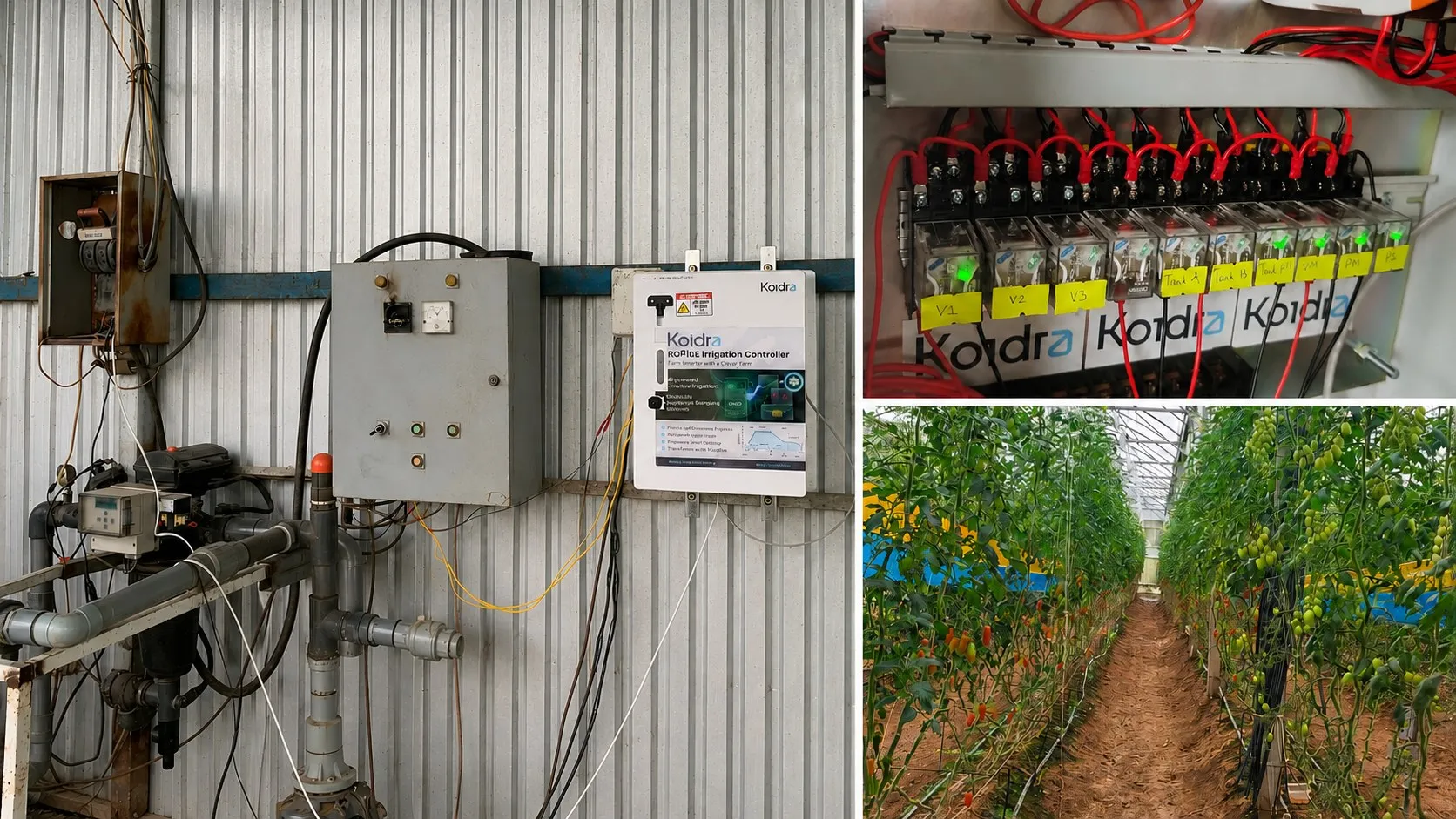
A greenhouse without an advanced climate computer takes a different path. DripPilot is a separate product: autonomous irrigation on its own controller, for the houses where water is the biggest lever and there is no climate computer to build on. It reads irrigation, climate and root-zone sensors and decides when to irrigate, how much, and what drain percentage and EC to hold. It is not a step on the path above, and not an add-on to Process Optimization.
Proof
- 2×
- Winner, Autonomous Greenhouse Challenge 2018 and 2022, a live crop each time
- 17%
- Higher net profit than the expert growers 2018 competition, with 6% higher yield
- 19.5%
- Yield increase 29.7 against 24.9 kg/m² in the growers' own zone
- 17%
- Energy savings lower electricity cost per unit, same lights in both zones
KoPilot, the autonomous control plan of Process Optimization, has been tested in international competition and in commercial greenhouses. In 2018, the technology behind it was the only AI entry to beat the expert growers on both yield and net profit. It does more than recommend a climate strategy. It makes the control decisions and applies them, day and night.
What our customers say
Koidra's system has changed how we grow. I no longer watch the conditions all day and keep adjusting the climate settings: KoPilot does it, fully automatically, and brings our crop measurements into every climate decision. And whenever we need help, the Koidra team responds right away.
I have seen firsthand the impact of Koidra’s data platform on controlled environment agriculture. Creating new insights using raw data and advanced calculations is relatively simple.
See Koidra on your greenhouse data
Bring a week of readings from one compartment. We will show you what the platform sees, what it would have flagged, and what it would have scheduled.