
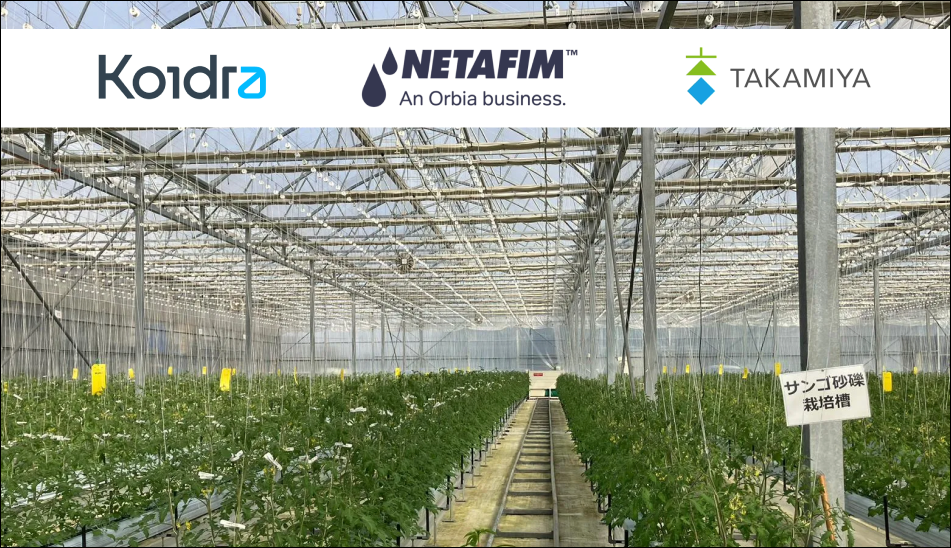

From November 2024 to July 2025, Takamiya, a Japanese greenhouse operator, partnered with KoPilot, Koidra’s AI-powered climate control system, during its first cherry tomato trial at the Hanyu greenhouse. The objective: support the transition to a new crop by delivering reliable automation, reducing manual workload, and allowing the team to focus on learning and cultivation.
This project was made possible through the collaboration between Koidra, Netafim Japan and Takamiya. Netafim Japan supported the deployment of KoPilot and acted as a bridge between Koidra and Takamiya, ensuring smooth communication and coordination throughout the trial.
“Transitioning from conventional climate control to KoPilot’s AI-driven automation has revolutionized how I manage my greenhouse. Previously, I spent hours adjusting settings- like humidity – to protect my cucumber crops from wilting. Now, KoPilot’s handles these tasks autonomously, maintaining perfect humidity and CO2 levels without my constant input.” – Taro Numazaki – Grower, Takamiya
About Takamiya and the Hanyu Greenhouse
Takamiya is a Japan-based multinational company specializing in the design, construction, and operation of large-scale greenhouses. The company’s Hanyu greenhouse, located in Saitama Prefecture, was the site of its first-ever cherry tomato cultivation, where growers adopted KoPilot’s automated climate control system in place of conventional manual methods. This marked both a crop transition and a move toward AI-assisted greenhouse management.
The project also forms part of the Takamiya Agribusiness Park (TAP) initiative, where Takamiya partnered with leading greenhouse suppliers such as Netafim Japan—to promote advanced greenhouse technologies and practices.
Trial Outcome and Benefits
Remarkable Tomato Yield
In their first-ever attempt at tomato cultivation, Takamiya achieved remarkably high yields, far exceeding initial expectations. This success was driven by KoPilot’s AI-powered climate control, which maintained optimal growing conditions without manual adjustments. As a result, growers confidently transitioned to a new crop with minimal reliance on external consultants.
The yield was so abundant that nearly 30% of the tomatoes cracked due to delayed harvesting. Despite this challenge, the premium quality and high output underscore KoPilot’s potential to revolutionize greenhouse farming, ensuring both efficiency and scalability for future operations.
Reduced Workload and Increased Focus
KoPilot eliminated the need for time-intensive manual adjustments to climate controls, which were necessary with the legacy system. For example, tasks like frequently adjusting humidity levels during cucumber cultivation were automated. This freed up growers’ time to focus on learning and refining tomato cultivation techniques, enhancing their skills while achieving better crop outcomes.
Operational Reliability with Real-Time Alerts
One unique challenge in Takamiya’s greenhouse is the gas-powered heating and CO₂ system, which requires periodic manual fuel refills. KoPilot’s Control Center provided real-time alerts for fuel shortages, enabling the team to refill promptly and avoid critical temperature drops during winter. This feature minimized risks and prevented crop damage due to unforeseen disruptions.

Conclusion
By working closely with Takamiya and in cooperation with Netafim Japan, Koidra ensured the grower’s first tomato crop was not only productive, but also manageable and low-stress.
“I started growing cherry tomatoes last year, but I had no knowledge of tomatoes. KOIDRA automatically controls the climate based on general tomato cultivation. I was able to devote my time to other tasks with peace of mind.” – Taro Numazaki
The result was a trial that provided more than a high yield: it gave the grower confidence, reduced their workload, and created space for learning and improvement, while showcasing the value of collaboration among Koidra, Netafim Japan, and Takamiya in advancing autonomous greenhouse management in Japan.
